Balancing Immediate Revenue and Long-Term Market Share
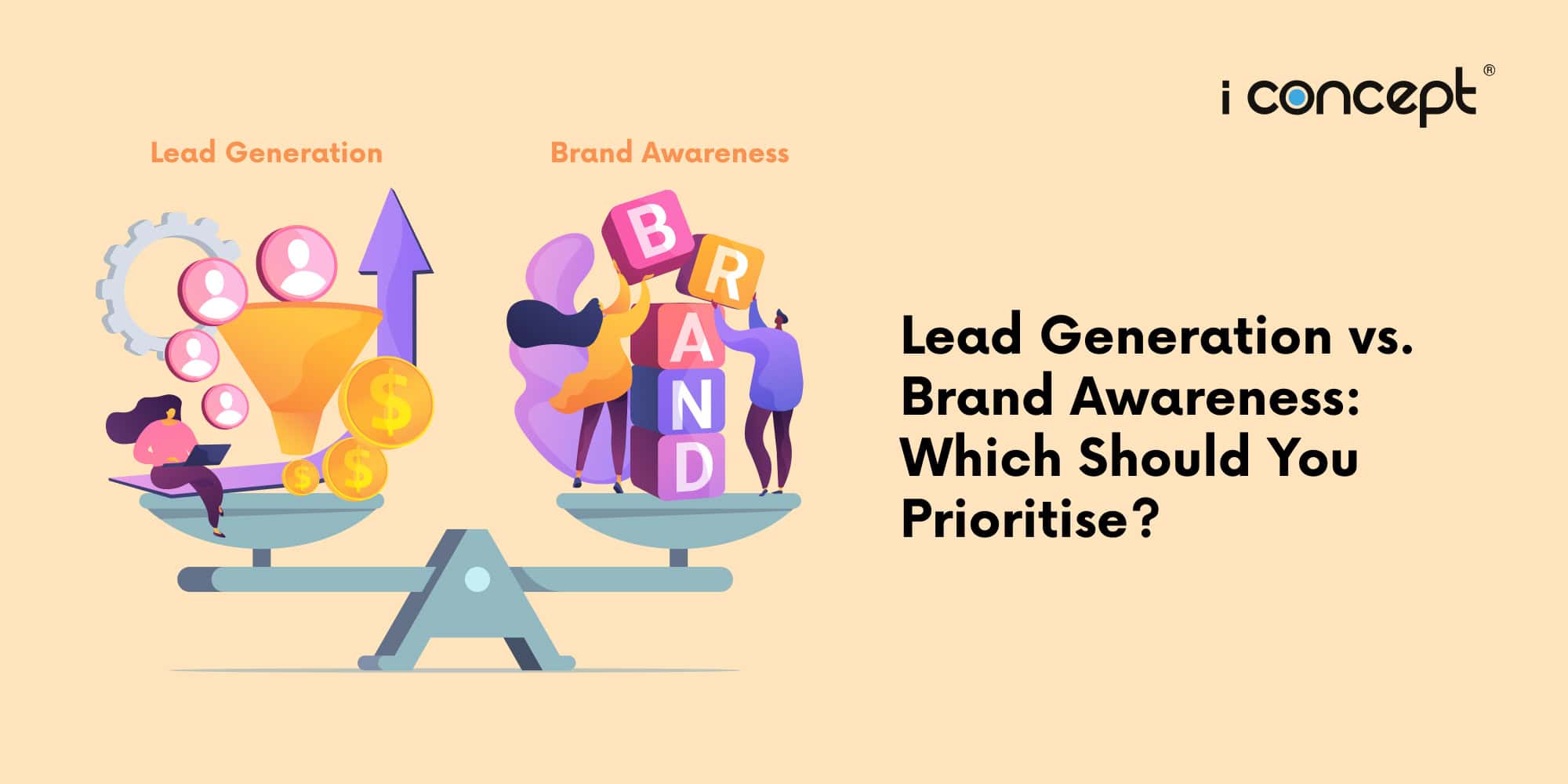
Businesses allocate marketing budgets to drive two distinct outcomes: immediate sales enquiries and long-term market recognition. Choosing between Lead Generation vs. Brand Awareness dictates a company’s cash flow stability and ultimate market valuation. A pure focus on immediate leads drives short-term revenue but often leads to rising acquisition costs over time. Conversely, investing solely in awareness builds a recognisable brand name but can starve a business of the cash needed to sustain daily operations.
Striking the correct balance ensures that a business remains profitable today while building an asset that reduces future marketing costs. For decision-makers, the goal is to understand how to transition dynamically between both strategies based on current market signals and organisational maturity.
Why It Matters: Market Shifts and Consumer Behaviour
The mechanics of how buyers find and evaluate businesses have changed fundamentally. According to the latest Gartner CMO Spend Survey, media spending funnelled directly into conversion and awareness jumped 10% as companies rushed to leverage artificial intelligence. However, the study warns that CMOs must guard against letting AI steer too much budget toward channels that are easiest to tune, while underinvesting in touchpoints that build long-term customer value.
www.marketingdive.com
Data from the HubSpot State of Marketing Report corroborates this shift, revealing that half of all consumers now use AI-powered search engines, and half of all Google searches include an AI overview. Consequently, 40.6% of modern marketers are actively updating their SEO strategies for search changes, prioritising Answer Engine Optimisation (AEO) to capture early-stage informational intent.
blog.hubspot.com
Furthermore, historical benchmarks compiled by Whitehat SEO regarding Binet and Field’s research demonstrate that whilst a 50:50 split between brand building and sales activation is optimal for B2B enterprises, the average marketer allocates 68.8% to short-term performance, leaving companies highly vulnerable to rising customer acquisition costs. Relying purely on transactional paid ads has become more expensive and less predictable year-on-year. Building a holistic digital marketing strategy requires a symbiotic relationship where top-of-funnel awareness actively lowers the friction of bottom-of-funnel conversion. When target audiences recognise a brand beforehand, ad click-through rates improve, and the overall cost per lead falls.
How Businesses Evaluate or Solve This Problem
Decision-makers must evaluate their market position, sales cycle length, and financial runway before shifting budgets between awareness and acquisition. A startup with limited capital must secure immediate cash flow, making direct-response inbound marketing critical for short-term survival. A mature enterprise, however, faces a growth plateau if it neglects the broader market funnel, as the pool of active buyers at any given moment represents only a fraction of the total addressable market.
Evaluating this problem requires looking at the total customer lifetime value against the immediate cost per acquisition. When buyers trust a brand, they spend less time evaluating alternatives, which directly accelerates the sales cycle. The ultimate objective is to deploy a balanced framework where awareness campaigns feed the pipeline, and lead generation harvesting tools capture the intent.
The 4 Principles of Balanced Marketing Allocation
To optimise marketing spend for both immediate survival and future scale, businesses can apply a structured, four-part framework. This operational model balances tactical demands with long-term asset building.
- Align with Business Maturity: Phase 1 Assessment.
Early-stage firms should skew up to 70% of their budget toward direct customer acquisition to validate product-market fit and generate cash flow. Established brands should reverse or equalise this ratio to protect market share against emerging competitors.
- Map Content to the Search Intent Journey: Asset Optimisation.
Ensure your corporate architecture and digital footprint support both informational searches (building authority) and commercial searches (capturing leads). This requires solid structural planning during your website development phases.
- Track Split Metrics Accurately: Data Calibration.
Measure lead generation via direct conversions, cost-per-lead, and pipeline velocity. Track brand awareness through organic baseline traffic, direct search volume, and branded search growth.
- Build Multi-Channel Funnels: Execution Phase.
Use top-of-funnel educational content to introduce your expertise to the market, then deploy precise middle-funnel remarketing campaigns to capture contact details once structural trust is established.
Common Pitfalls in Execution and Budget Misallocation
- Treating Awareness Like Lead Generation: Expecting immediate sales conversions from an educational piece or a brand-building campaign leads to the premature cancellation of valid long-term strategies.
- Neglecting User Experience Assets: Driving traffic via aggressive lead generation to a slow, confusing, or poorly designed platform reduces conversion rates. Without robust website development and optimised e-commerce design, high ad spend is fundamentally wasted.
- The Click-Through Trap: Relying entirely on short-term ad clicks without tracking long-term brand recall or organic search lift, leaving the business entirely dependent on continuous ad spend.
Navigating the Singapore Market and Competitive Ecosystem
The Singapore business landscape is highly competitive, compact, and digitally mature. Local enterprises must scale efficiently within a dense market where consumer trust is hard-won and shifting rapidly. To support local businesses in building sustainable market assets rather than relying purely on short-term ad spend, the Singapore government offers substantial strategic support.
Firms looking to overhaul their digital presence and brand positioning can leverage these government frameworks to offset costs. For deep structural upgrades – such as developing a comprehensive corporate identity or executing a long-term digital marketing roadmap – companies can apply for the Enterprise Development Grant (EDG). For modular digital adoptions, such as launching an optimised online storefront or automated retail channels, the Productivity Solutions Grant (PSG) offers accessible co-funding options for pre-approved e-commerce design platforms.
Real-World Case Models: Balancing the Scales
Let us look at how market leaders handle this balance. Consider a company like Ninja Van in its early growth phases within the region. They did not just run direct-response ads to merchants; they built massive top-of-funnel content and highly visible fleet branding to establish trust across Southeast Asia. By combining high physical visibility with hyper-targeted digital lead capture, they secured both immediate logistics contracts and long-term brand recall.
Similarly, local B2B software enterprises often publish comprehensive, ungated industry whitepapers to build organic authority. Once the target audience views them as market experts, the subsequent direct lead generation campaigns achieve significantly higher conversion rates at a fraction of the traditional cost.
What We Commonly See
At I Concept Singapore, our consultations with local business owners reveal a recurring pattern: a heavy over-reliance on performance marketing at the expense of long-term asset building. Many brands come to us when their digital ad costs spike or conversion rates drop, realising they have built zero brand equity to sustain organic traffic.
We observe that lead generation performance decays rapidly the moment the ad budget stops. True marketing efficiency occurs when a business couples tactical lead acquisition with a robust foundation in professional branding and professional website development. A website must serve as a high-converting ecosystem rather than a static brochure if it is to survive shifts in search technology.
Frequently Asked Questions
Can a business survive on lead generation alone?
While direct customer acquisition keeps a business operational initially, relying on it entirely becomes unsustainable. Over time, ad fatigue and rising competition drive up acquisition costs. Without building underlying brand equity, you must pay for every visitor continuously, eroding profit margins over the long term.
How long does it take to see results from brand awareness?
Brand building is a long-term investment that typically takes six to twelve months to show measurable impact on organic search baselines and direct traffic. However, this builds an enduring asset that lowers your customer acquisition costs over time, unlike paid ads which stop delivering the moment budgets disappear.
What grants can Singapore SMEs use for digital marketing and branding?
Singapore enterprises can utilise the Enterprise Development Grant (EDG) for core strategic transformations like comprehensive branding and large-scale digital marketing roadmaps. For tactical adoptions, such as setting up automated retail channels, the Productivity Solutions Grant (PSG) provides structured financial support.
How does website design impact lead generation vs brand awareness?
Your website bridges both strategies. Professional design and smooth user journeys reflect your brand identity, building trust during the awareness phase. Concurrently, optimised conversion pathways and clear call-to-action elements are vital to capturing high-quality transactional leads effectively, ensuring your paid media spend translates into tangible business growth.
Securing Future Growth Through Strategic Equilibrium
Choosing between lead generation and brand awareness is not a binary decision – it is a matter of strategic timing and resource allocation. Immediate survival requires actionable leads, but sustainable market dominance demands a trusted brand name. Businesses must cultivate both to thrive in a modern search ecosystem where authority and user experience are heavily weighted by discovery algorithms.
Accelerate Your Business Growth
Navigating budget allocations while scaling a business requires a clear, data-driven approach. Whether you need to establish a distinct market identity through professional branding or deploy a high-performing digital marketing roadmap, having an experienced local partner makes a decisive difference.
Get in touch with the team at I Concept Singapore to discover how we can design and optimise your growth strategy. Contact us today to align your marketing investments with your long-term business goals.