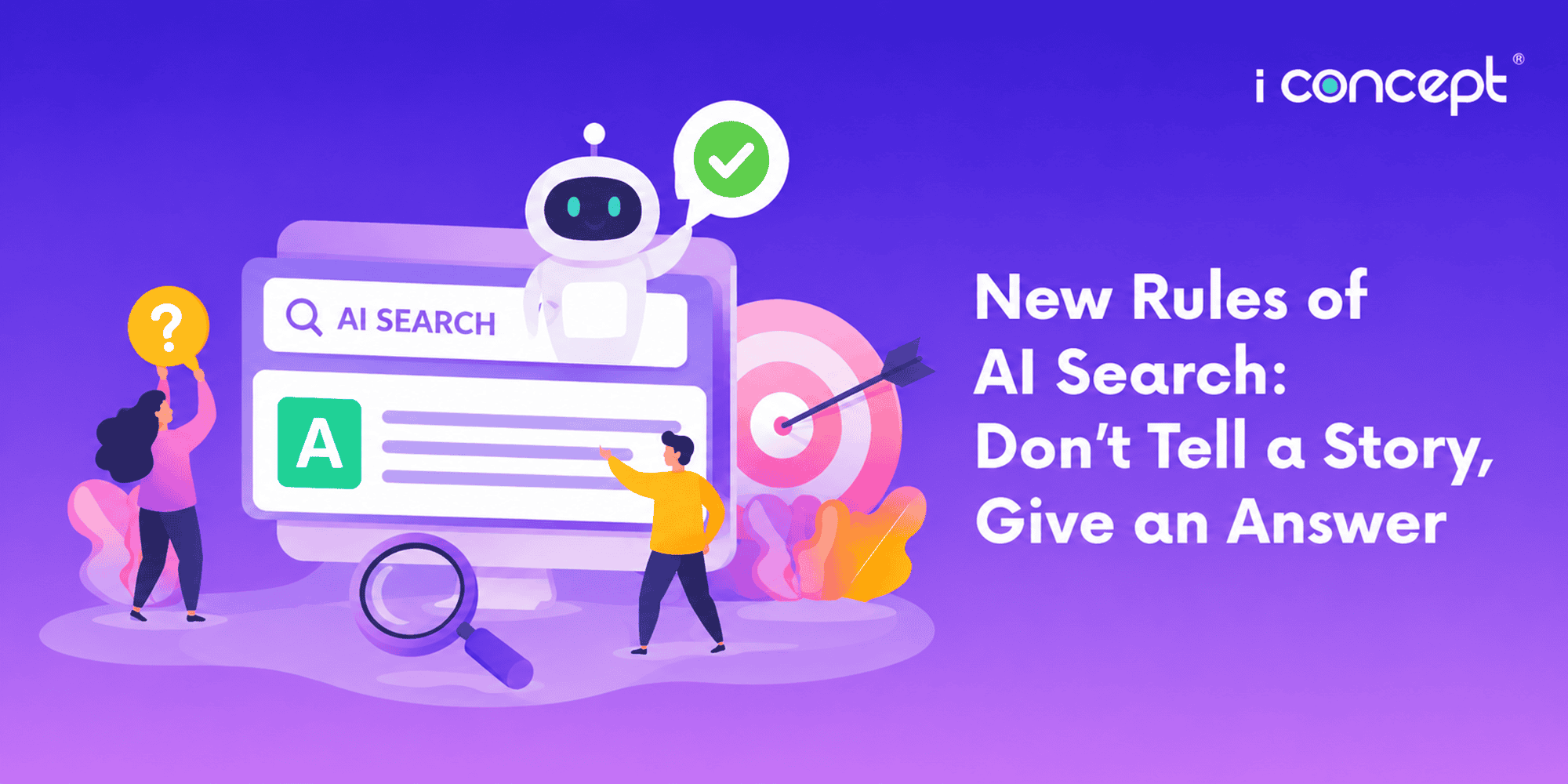
The primary rule of AI search is to deliver direct, extractable answers to secure citations from generative engines. Traditional page rankings are losing their dominance. Content must now be engineered for AI parsing before human reading.
Gartner predicted that traditional search engine volume will drop by 25% by 2026, a forecast that is now playing out, driven by a rapid consumer shift towards conversational AI answers. This fundamental market shift means businesses must abandon lengthy brand narratives at the top of their webpages. AI systems prioritise direct, extractable responses. If an AI engine is forced to guess the context of a page, it will simply cite a competitor that provides a clearer answer. With Google’s Generative UI, announced at Google I/O in May 2026 and rolling out progressively across markets, dynamically building custom visual layouts from web content, pages that lack an immediate, structured response are already operating at a disadvantage.
The Shift To Generative Engine Optimisation
Generative Engine Optimisation builds on the same foundation as traditional SEO. Crawlability, indexation, and authority still apply. What has changed is the layer above that foundation. Generative engines now require facts to stand entirely alone. Long preambles and narrative warm-ups cause AI systems to skip the content entirely. Every section must lead with an immediate, factual answer of one to two sentences.
Recent industry data from BrightEdge indicates that generative AI elements are already present in over 80% of search queries across major sectors. To capture this visibility, your strategy for digital marketing in Singapore must evolve. Marketing campaigns must prioritise pure information gain – offering proprietary data, internal benchmarks, and original industry observations. Commodity content that simply repeats generic tips is actively ignored by modern algorithms. Key facts must be presented in short, standalone sentences. For example, if a user asks about the cost of a digital service, the exact figure must appear in the very first line. Complex paragraphs that merge multiple claims confuse parsing tools and break extractability.
Case Study: Adapting Structured Data For AI Dominance
In May 2026, Google officially deprecated FAQ rich results from traditional search, completing a restriction that had been rolling back since 2023. While many marketers panicked at the loss of visual drop-down snippets, forward-thinking agencies recognised the true signal: the era of manual visual SERP features is giving way to pure generative AI parsing.
While the visual FAQ snippet is gone, structured data remains a useful signal. Not because it unlocks AI citations on its own, but because it helps search engines verify facts, understand your inventory, and establish trust more efficiently. Google’s own guidance confirms that schema markup is not a requirement for generative AI features, but it does support eligibility for rich results and makes your content easier for automated systems to interpret accurately.
A recent e-commerce AI SEO case study demonstrated how implementing a comprehensive Organisation and Product schema generated a 91% increase in monthly organic revenue within eight months. By marking up their domain with explicit credentials and ensuring their product data was cleanly structured for machine reading, the brand captured over 160 direct AI citations across platforms like ChatGPT and Google’s generative interfaces.
Organisation and Product schema in particular serve as supporting verification tools. They give AI systems cleaner access to your E-E-A-T credentials, live pricing, specifications, and availability, reducing the friction between your content and how AI surfaces it in conversational answers. Brands that maintain clean, consistent schema across every page give AI systems fewer reasons to hesitate before citing them.
What does an AI-ready website actually require?
An AI-ready website needs three things: modular content structure that leads with direct answers so generative engines can extract meaning without guessing; semantic HTML that prioritises human readability first (Google has confirmed that perfect semantic code is not required, but clear and logical structure helps both readers and machines); and schema markup consistently maintained across every page as a supporting trust signal. One thing you do not need is special AI files like LLMS.txt or new machine-readable markup formats. Google has explicitly stated these are unnecessary to appear in generative AI search results.
How does I Concept Singapore approach AI Search Engine Optimisation?
I Concept Singapore integrates our core disciplines – branding strategy, digital marketing, and e-commerce development – into a single AI-ready framework, rather than treating them as isolated workstreams. This means every element is engineered for citation readiness from the start, not retrofitted after launch. Our branding strategy establishes the verified E-E-A-T credentials that generative engines require, while our digital marketing campaigns prioritise answer-first content and proprietary data gain over generic storytelling. Simultaneously, our e-commerce development ensures precise schema markup and flawless semantic HTML, creating a structured digital environment that AI models can instantly parse and confidently cite.
GEO and SEO are not competing disciplines. They share the same technical foundation, and that is precisely why our integrated approach produces stronger and more durable results than treating them as separate workstreams.
What is answer-first content and why does it matter for digital marketing in Singapore?
Answer-first content leads every section with a direct, standalone response before any supporting detail. This is the format generative engines extract from. Content that buries its answer in narrative paragraphs is consistently skipped in favour of pages that give AI systems an immediate, clean response to surface.
How does branding strategy connect to AI citations?
AI engines prioritise sources they can verify as authoritative. Publishing original data, proprietary benchmarks, and industry-specific insights establishes your business as a primary source rather than a content aggregator. Brands that own original data are cited more frequently and more consistently across generative platforms.
Generative AI is actively reshaping how consumers find and interact with your business. Do not wait for your digital traffic to drop before making a structural change. Contact I Concept Singapore today to rebuild your digital presence for the generative search era.